Launch offer — valid today only

📄 Digital book in PDF · read it on your phone or print it

Irrigation Design for the CID Exam, Fully Illustrated Every Calculation Solved in Order

Site survey, static and dynamic pressure, head spacing, precipitation rate, zoning, pipe sizing, friction loss and run times. Each topic gets its own page: first the drawing, then what you need to remember. 64 illustrated pages.

START STUDYING IN ORDER

🔒 Secure checkout · PDF by email · 30-day guarantee

Every topic, its own pageEach calculation drawn, with the worked steps right beside it
64 illustrated pages8 parts, from the design sequence to the final checklist before you submit a plan
Up-to-date sourcesThe published CID exam content outline and EPA WaterSense guidance
PDF by emailFormat

Look Inside the Book

Every page has one big drawing and a box with the formulas and numbers you need to know:

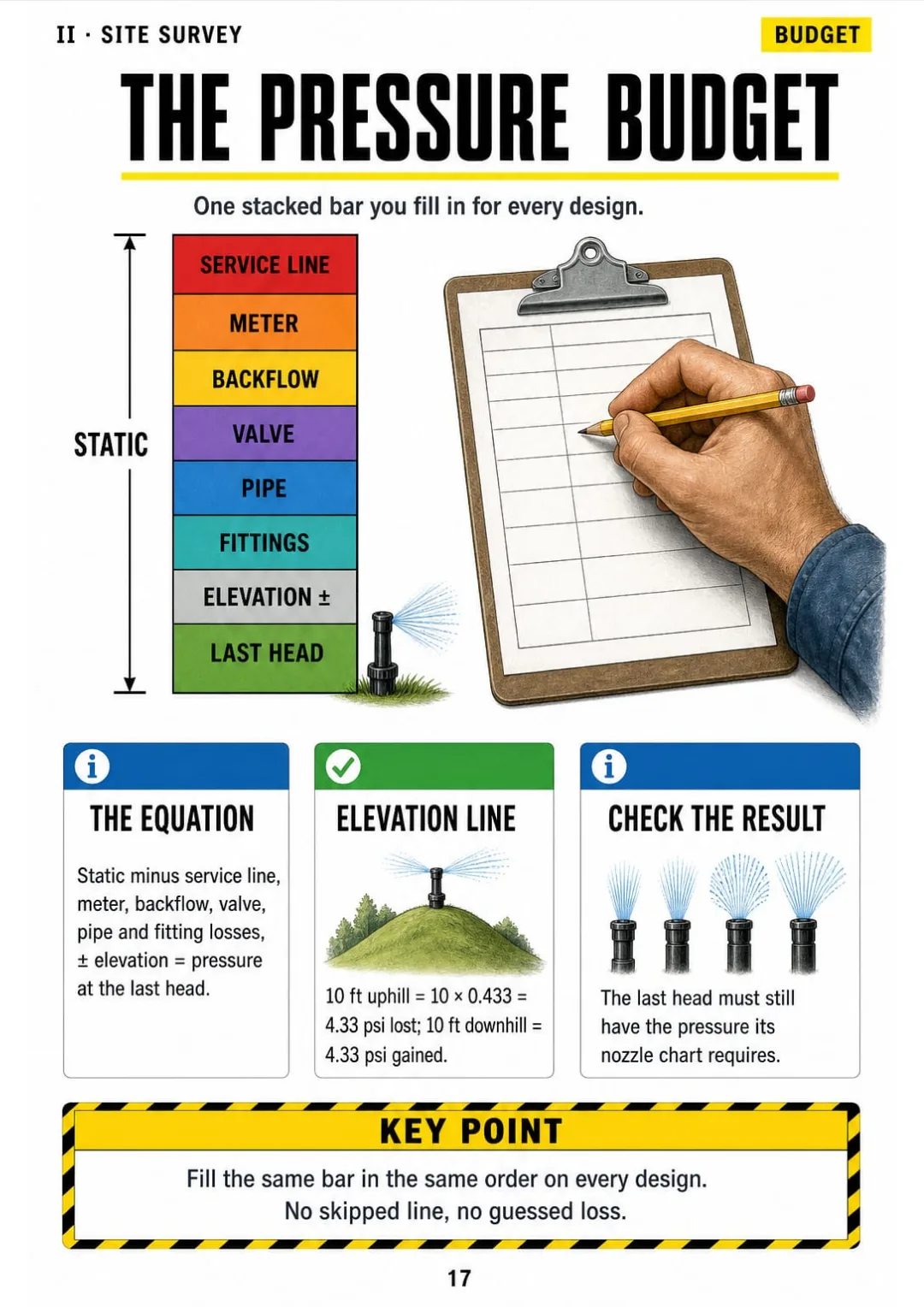
Pressure budget: static minus service line, meter, backflow, valve, pipe, fittings, ± elevation = last head.
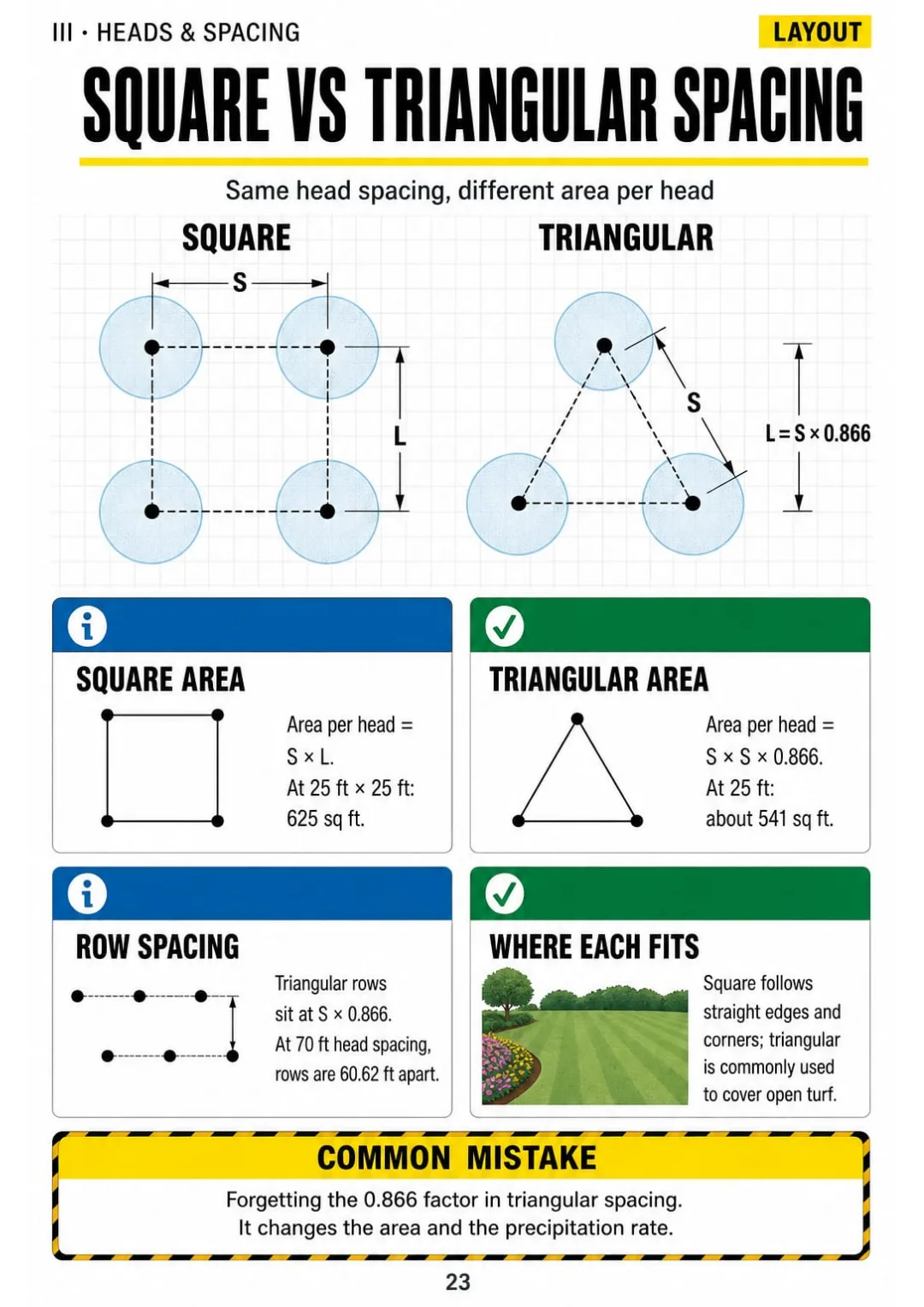
Square S × L vs triangular S × S × 0.866: area per head at a glance.
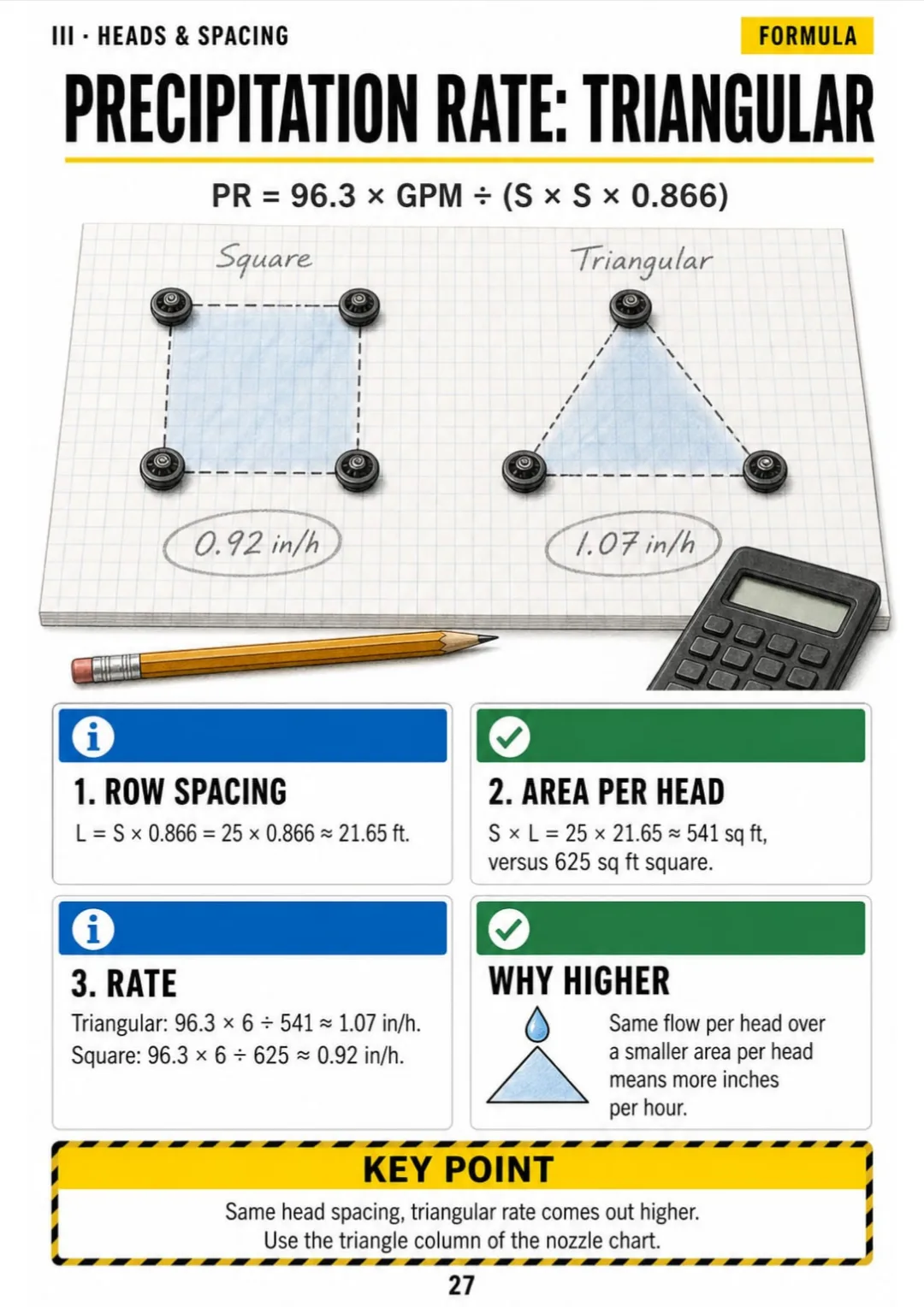
6 GPM at 25 ft: about 0.92 in/h square vs 1.07 in/h triangular.
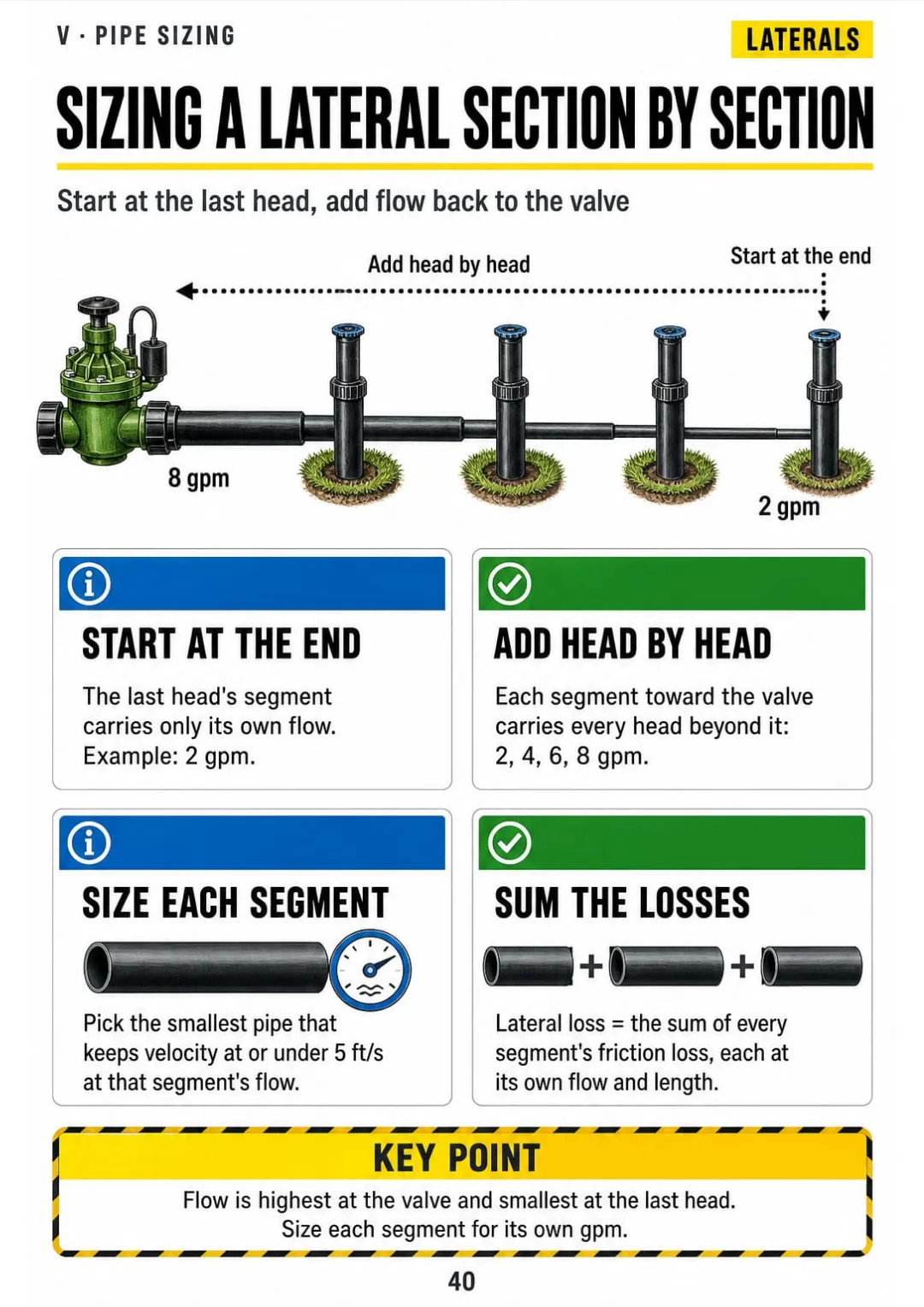
Four 2-gpm heads: segments carry 2, 4, 6 and 8 gpm back to the valve.
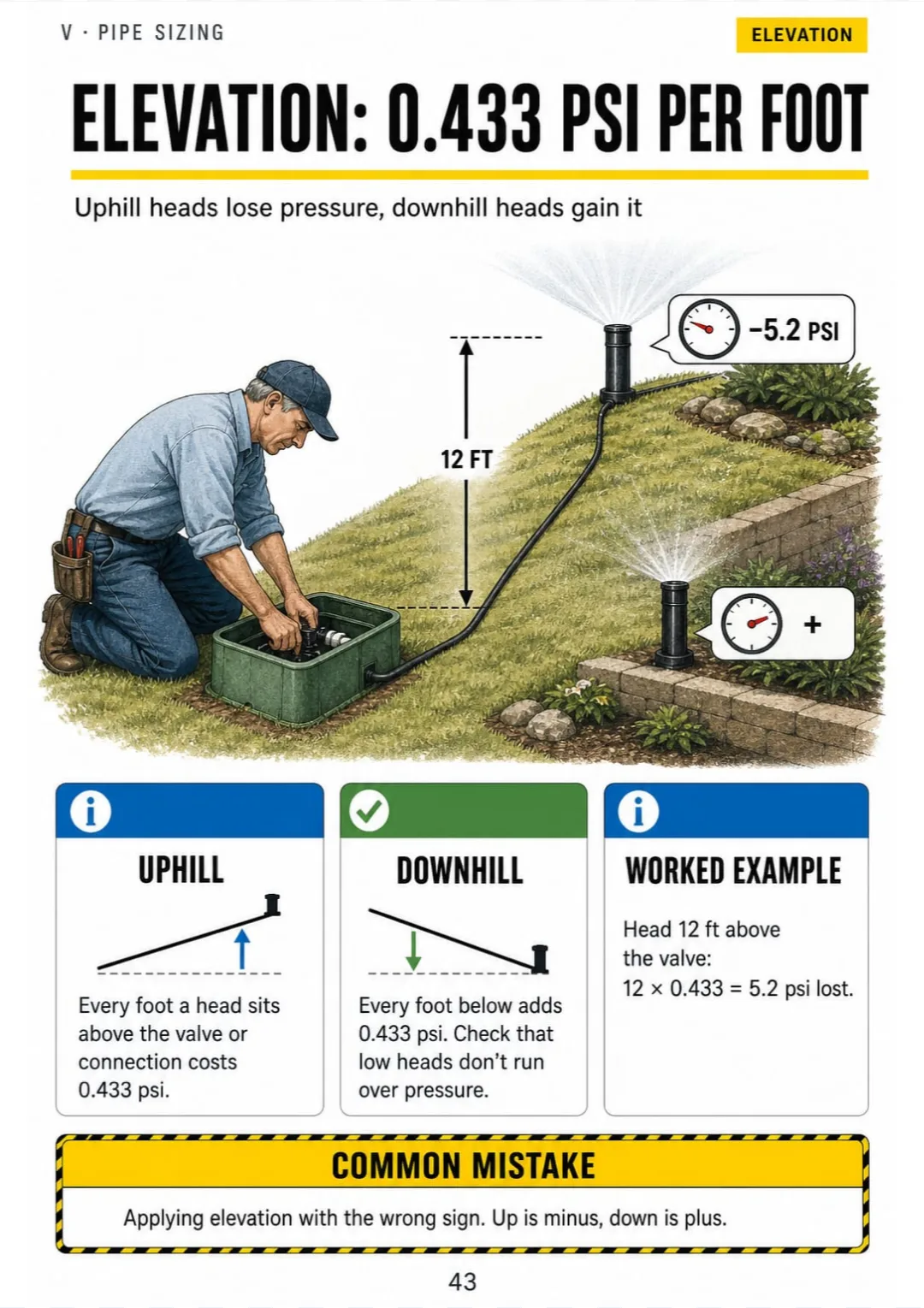
0.433 psi per foot: a head 12 ft uphill loses about 5.2 psi.
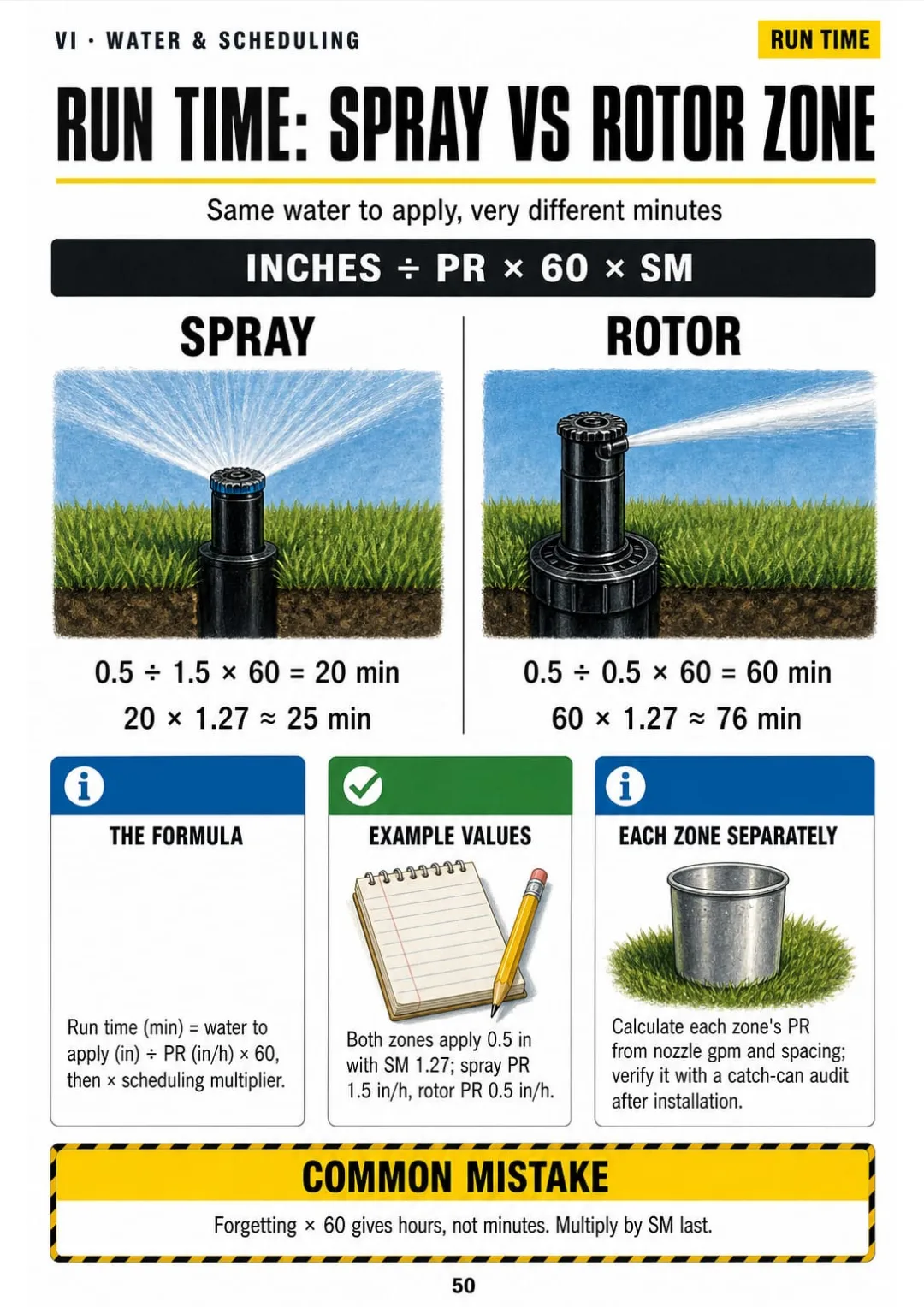
Run time = inches ÷ PR × 60 × SM, spray and rotor solved side by side.
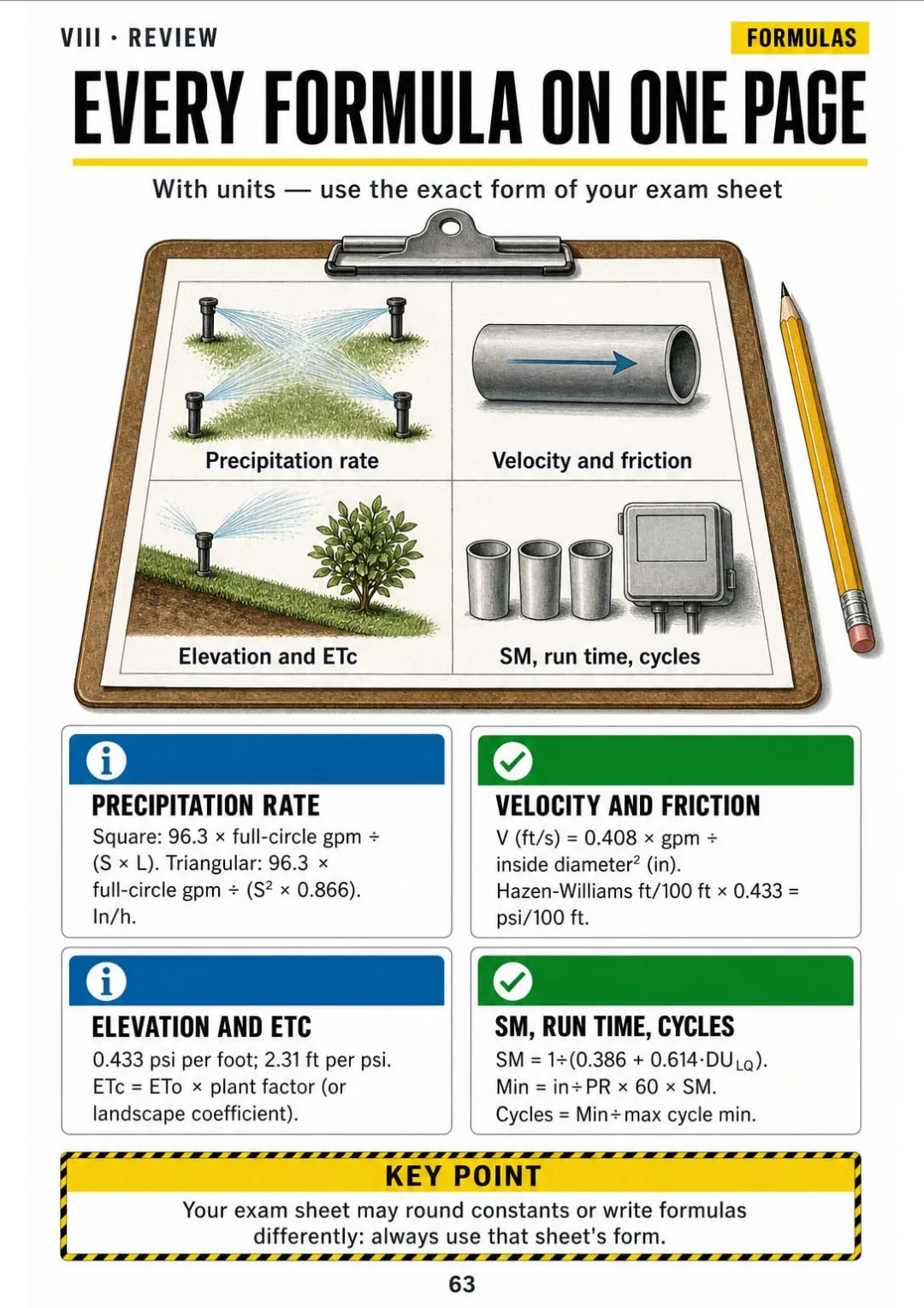
PR 96.3 × gpm ÷ (S × L) · V = 0.408 × gpm ÷ d² · 0.433 psi/ft · SM · run time
12 yes/no checks in design order: supply, hydraulics, pressure, run times, legend and controller chart

Swipe to see more →

These are real pages from the book. The table of contents is the full one: 8 parts and 60 topics.

The Problem Isn't You. It's How It Was Explained to You.

You're at the kitchen table with a practice problem: spray heads at 25 ft, triangular spacing, 6 GPM. It wants the precipitation rate in inches per hour.

You know there's a 96.3 in the formula. But the manual covers the triangular version in two paragraphs, with the 0.866 buried in a sentence. So you divide by S × L and get the square answer instead.

6 GPM at 25 ft: about 0.92 in/h square vs 1.07 in/h triangular.

In the book, that's one page. The square and the triangle are drawn side by side, the 0.866 sits right on the triangle, and the example is worked out: about 0.92 in/h square, about 1.07 in/h triangular.

The pressure budget, sizing a lateral section by section, elevation at 0.433 psi per foot, spray and rotor run times: each one gets its own page too.

Next time a problem says triangular, you picture the page, pick the right area and solve it without opening the manual. And you can explain that number to a client or an inspector.

COMPARE FOR YOURSELF

Same Topic, Two Ways to Study It

THIS
  • The manual: line after line of text
  • Spacing patterns explained only in words
  • Square or triangular? You guess which area to use
Sprinkler head layouts are generally classified as either square or triangular patterns. In square spacing, heads are located at the corners of a square, the distance between heads (S) being equal to the distance between rows (L), and the area served by each head is therefore calculated as S × L. In triangular, or equilateral, spacing, the row spacing is reduced to 0.866 of the head spacing, so that the effective area per head becomes S × S × 0.866, which generally results in more uniform overlap across the irrigated area.
FOR THIS
  • Square and triangular spacing in one drawing
  • The 0.866 and the area formulas in a box
  • You see which area goes in the formula before you calculate
Square S × L vs triangular S × S × 0.866: area per head at a glance.
CONTENTS

Take a Look at the 8 Parts and 60 Topics

The design sequence, site survey and water supply, heads and precipitation, zoning, pipe sizing and friction loss, water need and scheduling, drawing the plan, and a full design solved with the final checklist: 64 pages, all illustrated

IThe Design Sequence · pp. 5-9
  1. One order, every design
  2. What a finished irrigation plan contains
  3. The US units you'll use all day
  4. Five conversions to know cold
  5. How to solve a calculation on paper
IISite Survey & Water Supply · pp. 10-18
  1. The base map: measure before you draw
  2. Slopes, elevation and low spots
  3. Soil texture and intake rate
  4. Static pressure: the reading with no water moving
  5. Dynamic pressure: what's left with water flowing
  6. Meter size and service line
  7. Maximum available flow
  8. The pressure budget
  9. Backflow prevention at the point of connection
IIIHeads, Spacing & Precipitation · pp. 19-27
  1. Sprays, rotors, bubblers, drip
  2. Reading a manufacturer's nozzle chart
  3. Operating pressure: too low, too high
  4. Head-to-head coverage
  5. Square vs triangular spacing
  6. Wind and spacing
  7. Matched precipitation
  8. Precipitation rate, square spacing
  9. Precipitation rate, triangular spacing
IVZoning · pp. 28-33
  1. Hydrozones: group by water need
  2. Never mix sprays and rotors
  3. Sun, shade and slope as zone breaks
  4. Zone flow limit
  5. Placing valves and manifolds
  6. Drip zones
VPipe Sizing & Friction Loss · pp. 34-43
  1. Mainline vs laterals
  2. Pipe types and pressure classes
  3. Velocity in the pipe
  4. Friction loss: water rubbing the pipe
  5. Reading a friction loss chart
  6. Hazen-Williams in plain steps
  7. Sizing a lateral section by section
  8. Sizing the mainline
  9. Fittings, valves and components
  10. Elevation: gain or lose 0.433 psi per foot
VIWater Need & Scheduling · pp. 44-53
  1. Reference evapotranspiration (ETo)
  2. Plant factor and landscape coefficient
  3. Root zone and soil water holding
  4. Management allowable depletion
  5. Distribution uniformity (DU)
  6. Scheduling multiplier
  7. Run time in minutes
  8. Cycle and soak
  9. Controllers and sensors
  10. The landscape water budget
VIIDrawing the Plan · pp. 54-58
  1. Scale and title block
  2. Symbols and legend
  3. Labeling zones, pipe and flow
  4. Installation details and notes
  5. Handing over the schedule
VIIIReview & Exam Practice · pp. 59-64
  1. A full design, start to finish
  2. Pressure check at the farthest head
  3. Most frequent calculation mistakes
  4. Most frequent layout mistakes
  5. The formula page
  6. Final checklist before you submit a plan

One Page, One Topic, All Clear

Think of it this way:

A commercial job asks for the irrigation plan with the pressure at the farthest head. You have to show where every psi went.

You open the pressure budget page: static pressure at the top, then the service line, meter, backflow, valve, pipe and fittings taken off one by one, elevation added or subtracted, and what's left at the last head.

0.433 psi per foot: a head 12 ft uphill loses about 5.2 psi.

Same with head spacing, matched precipitation, hydrozones, friction loss and run times: each one on its own page, drawn in the order you design.

Irrigation Design Illustrated is 8 parts and 60 topics, all drawn, and at the end a full design solved start to finish, the formula page and a final checklist.

What you see drawn, you don't have to memorize.

What's Inside Irrigation Design Illustrated:

Ipp. 5-9

The Design Sequence

One design sequence for every job, what a finished plan contains, US units, five conversions and how to solve a calculation on paper.

IIpp. 10-18

Site Survey & Water Supply

You know what pressure and flow you really have before you place a single head: base map, slopes and low spots, soil intake rate, static and dynamic pressure, meter and service line, available flow, the pressure budget and backflow.

IIIpp. 19-27

Heads, Spacing & Precipitation

Sprays, rotors, bubblers and drip, nozzle charts, operating pressure, head-to-head coverage, square vs triangular spacing, wind and precipitation rate.

IVpp. 28-33

Zoning

Hydrozones, why sprays and rotors never share a zone, sun, shade and slope as zone breaks, the zone flow limit, valves and drip zones.

Vpp. 34-43

Pipe Sizing & Friction Loss

You size every pipe by the numbers, not by habit: mainline and laterals, pipe classes, velocity, friction loss charts, Hazen-Williams in steps, sizing laterals and the mainline, fittings and elevation.

VIpp. 44-53

Water Need & Scheduling

ETo, plant factor, root zone, allowable depletion, DU, scheduling multiplier, run time, cycle and soak, controllers and the water budget.

VIIpp. 54-58

Drawing the Plan

Scale and title block, symbols and legend, labeling zones and pipe, installation details and the schedule you hand over.

VIIIpp. 59-64

Review & Exam Practice

A full design start to finish, pressure at the farthest head, the most frequent mistakes, the formula page and a final checklist.

At the end of the book: A full design solved start to finish, the formula page and a 12-point checklist before you submit a plan.

Plus: 2 Free Books

Irrigation Design Practice Tests

BONUS 1: «Irrigation Design Practice Tests»

Value on its own: US$ 17.90

Exam-style questions with every answer explained step by step, so you find out what you still miss before exam day, not during it.

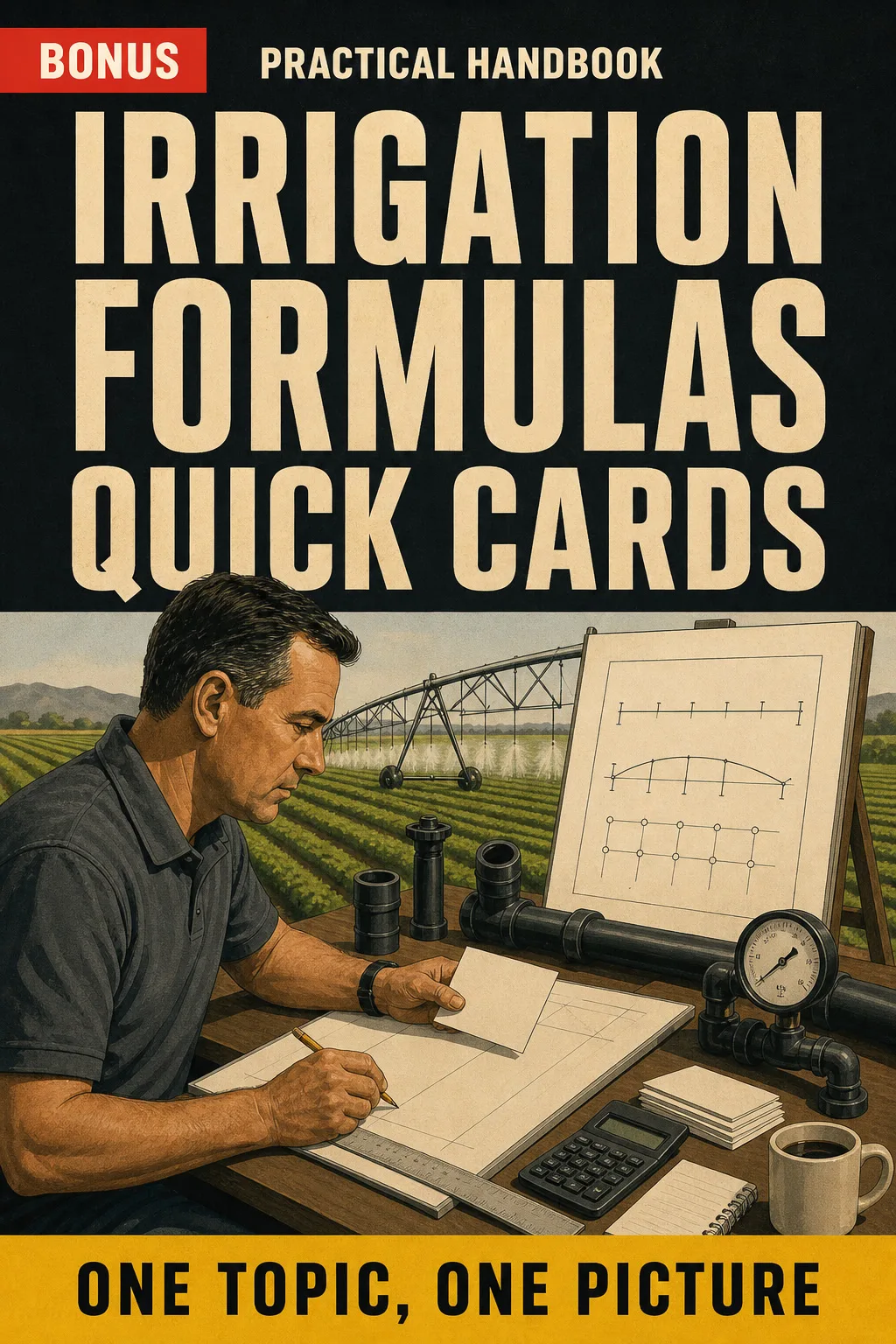
Irrigation Formulas Quick Cards

BONUS 2: «Irrigation Formulas Quick Cards»

Value on its own: US$ 14.90

Precipitation rate, GPM, friction loss, velocity and run-time formulas on printable cards, each with its units and a mini example, to review in five minutes.

Irrigation Design Illustrated with 2 Free Books

  • Irrigation Design Illustrated: 64 illustrated pagesUS$ 63
  • BONUS 1: Irrigation Design Practice TestsUS$ 17.90
  • BONUS 2: Irrigation Formulas Quick CardsUS$ 14.90
  • High-resolution PDF to printIncluded
Total value US$ 95.80
YOUR PRICE:
US$ 27
You save US$ 68.80
YES, I WANT IRRIGATION DESIGN ILLUSTRATED FOR US$ 27

📄 This is a digital PDF book sent to your email: nothing is printed or shipped.

Secure purchaseEncrypted payment30-day guarantee

PDF by email: We email you Irrigation Design Illustrated as a PDF, together with the two free books. It's a single payment: no installments, no extra charges.

Who This Book Is For

You're studying for the CID exam

You're studying for the CID exam

Every calculation sits on the step it belongs to, so the formulas stop floating around. You study in the same order you'd design.

Your exam date is close

Your exam date is close

The formula page, the practice tests and the quick cards let you review in short sessions and find what you still miss before exam day.

You already design and install

You already design and install

You keep it in the truck or on the desk and check a pressure budget or a run time in a minute. And if you draw the planting plan, it walks you through the irrigation plan that goes with it, with numbers you can justify to a client or an inspector.

Everything You Get Today

US$ 95.80US$ 27
YES, I WANT IRRIGATION DESIGN ILLUSTRATED FOR US$ 27

📄 This is a digital PDF book sent to your email: nothing is printed or shipped.

30DAYS
GUARANTEE

30-Day Guarantee

Try Irrigation Design Illustrated for 30 days, bonus books included.

We refund everything if the file won't open, if the book isn't what you see here, if you were charged twice or if the email doesn't arrive. Just email us.

You pay once. No subscriptions.

Frequently Asked Questions

Is it for me if I've been installing irrigation for 20 years?

Yes. It doesn't teach you how to trench. It puts the design math in order (pressure, precipitation, pipe sizing, run times) in US units: psi, GPM, feet and inches per hour. So you can do on paper what you already do in the field.

Where does the content come from?

From the content outline the Irrigation Association currently publishes for the Certified Irrigation Designer exam, checked topic by topic, plus US EPA WaterSense guidance on water budgets and controllers. All in US units: psi, GPM, feet, inches per hour. Backflow rules and local codes vary by state: always check yours.

Is this official material?

No. It's an independent study companion. It doesn't give you a certificate or continuing education credits: the certification comes only from passing the exam. It is not affiliated with, endorsed by or approved by the Irrigation Association or the EPA.

Does it replace a course or formal training?

No. It's for studying and reviewing. It doesn't replace training, field experience, manufacturer data or your local code.

Are the practice questions the ones on the exam?

No. They're written for this book, on the topics in the exam outline, with every answer explained step by step. They are not official exam questions.

When and how do I get it?

The book and the 2 bonus books come as PDF by email, to the address you enter at checkout.

Do I have to pay every month?

No. It's a one-time payment. No subscription.

Can I have it on paper?

Yes. Print the PDF at home or at a print shop and keep it in the truck.

How does the refund work?

You have 30 days. We refund everything if the file won't open, if the book isn't what you see on this page, if you were charged twice or if the email doesn't arrive: just email us.

Before You Close This Page

No more rereading the manual with nothing sticking.

Precipitation rate and friction loss, drawn and done.

You walk into the exam knowing where every number goes.

Drawings make studying faster.

The book is right below.

One-time payment: US$ 27 · Guarantee: 30 days · PDF by email

YES, I WANT IRRIGATION DESIGN ILLUSTRATED FOR US$ 27

📄 This is a digital PDF book sent to your email: nothing is printed or shipped.